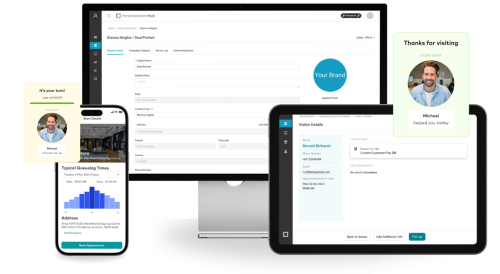
Use cases supported by Personalisation Hub
Personalisation Hub supports 3 primary use cases: a connected and personalised retail experience, first-party audience targeting in-store and hyper-localised campaigns for every store. For telcos and banks the predominant use case, and the benefit customers measure first, is passer-by traffic: turning more of the people walking past into visitors, then converting more of them once they are inside. This page describes each scenario and links to the articles that set it up. For the sector view, see Benefits by industry.
Core platform features
All 3 use cases build on the same features. The platform runs entirely within your own AWS account and private VPC — see Where is my data stored and how is the platform secured?.
Use case 1: connected and personalised retail experience
Applies to telco, banking and brick-and-mortar retail. The goal is in 2 parts: shopfront displays bring more passers-by into the store, and the visitor's phone, the store's displays and the staff tablet then turn the visit into a conversion.
Passer-by traffic
Street-facing displays play campaigns chosen for that store, that time of day and, with computer vision at the edge, the people walking past at that moment, and a QR code on the screen lets a passer-by act on the offer straight away. See Target passers-by using computer vision at the edge, Target campaigns at specific displays with display tags and Enable QR Control and set the default QR code settings.
Virtual queues and appointments
Visitors join a virtual queue from a display, the staff tablet or their own phone, or book an appointment ahead of the visit, and receive SMS updates while they browse. See Enable virtual store queueing and Enable appointment bookings.
Connected customer journeys
The visitor's phone, the store's displays and the staff tablet share 1 session, so what a customer browsed online or scanned in store follows them to the person serving them. See Personalise a visitor's store experience.
Dynamic QR code engagement
A QR code on any display opens the store's mobile site, joins the queue or triggers a campaign, and its destination is changed centrally without reprinting anything. See Enable QR Control and set the default QR code settings.
Staff tablet
Retail Admin on a tablet gives staff the queue, each visitor's profile and recent interactions, and the store's own settings in 1 place, so the conversation starts informed. See View a visitor's recent interactions and profile data.
Intended outcomes. More passers-by entering the store and a higher conversion rate once inside, with shorter perceived wait times, better-informed conversations with staff, a connected experience between online and in-store, and conversion and retention measured in Insights / Analytics and your own analytics.
Use case 2: first-party audience targeting in-store (e.g. for retail media)
Uses loyalty and other customer or decisioning data to target in-store campaigns as support for third-party cookies decline.
Automatic store check-in
A known customer is recognised on arrival through your mobile app or proximity beacons, and their profile decides which campaigns the displays show. See Connect your mobile app or third-party system to the Visitor API and Enable proximity personalisation with MIST.
Connected customer journeys
Loyalty and CDP attributes sent to the Visitor API target the campaigns a customer sees on displays and mobile sites during the visit. See Trigger campaigns from customer or decisioning data.
QR code store check-in
A visitor scans a QR code to identify themselves, which links their online profile to the store visit with no app installed. See Use customer and decisioning data to personalise the store visit.
Programmatic advertising slots (coming soon)
Localised, personalised and sponsored ad slots that a brand designates for advertisers, bookable in advance or filled programmatically, with DSP integrations planned. This capability is on the roadmap and is not in the platform today.
Intended outcomes. Larger baskets and higher conversion, monetisation of in-store media, closed-loop attribution through the Downloads reports, and the ability to change a campaign in real time. See Review campaign performance in Insights / Analytics.
Use case 3: hyper-localised campaigns (for every store)
Leverage any local data to dynamically control which campaigns get played across each store's website, within your mobile app and on digital signage in-store.
Day-parting (advanced scheduling)
Campaigns and offers are scheduled by time of day, day of week or each store's opening hours, so morning, lunchtime and evening content switches on its own. See Schedule a campaign.
Dynamic data integration
Prices, stock levels and local conditions feed campaign rules and the Visitor API, so a sold-out item drops off the display and a hot-day offer appears where it is hot. See Trigger campaigns from customer or decisioning data and Localise campaigns with store segments.
Personalised offers
Offers vary by store segment, time and detected audience, using the same rule builder as every other campaign. See Target a campaign.
Vision at the edge (audience sensing)
A camera-equipped player detects audience attributes on the device itself, no images leave it, and campaigns respond in real time. See Target passers-by using computer vision at the edge and Does computer vision store images of shoppers?.
Intended outcomes. Higher sales per visit, more engagement with offers, campaign decisions based on playback and audience data, and less waste from promoting items that are out of stock.
Related
Last updated 17 September 2026