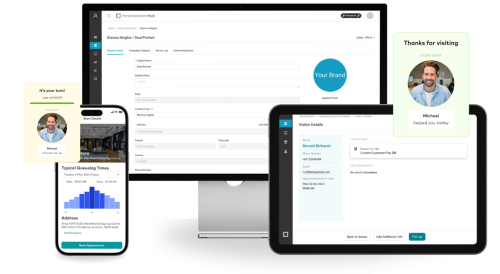
How displays and devices work in Personalisation Hub
A display is any screen that plays campaigns from Personalisation Hub: a shop-front screen, a menu board, a concierge kiosk or a signage stick plugged into a TV. The device is the hardware (or player) behind that screen. Personalisation Hub tracks both, so you can see which campaigns are playing where and fix problems before they cost you sales.
A display's life cycle
- Digital signage is enabled for the organisation under Platform Admin → Enabled Features → Digital Signage, and for each store under the store's Enabled Features tab. See Enable digital signage.
- The device connects to your platform domain, either through the Personalisation Hub app on an Amazon Signage stick or through a kiosk player pushed by your device management (MDM/CDM) solution. It shows a registration code and appears under Displays & Devices → Unassigned Devices.
- You register it with a display name, a store and a display type. It moves to Assigned Devices and starts playing the display type's default playlist. See Register a new display or device.
- Campaigns play on it according to the playlist, the campaign's targeting and any triggered interactions. The platform records every playback and every status change.
Display types and playlists
A display type describes a class of screen: its touch point (Digital Signage, Website or Mobile App), its resolution and its orientation, for example Landscape at 1920 x 1080 or Portrait at 1080 x 1920. Every display type has a default playlist, and every display of that type plays that playlist unless a campaign is targeted more narrowly. Creating the right set of display types up front is what lets you manage campaigns for hundreds of screens at once. See Create a display type and playlist.
What the platform tracks for each display
| Information | Where to find it | Use it for |
|---|---|---|
| Online / offline status and time offline | Status column in the Displays & Devices list | Morning checks; hardware or network faults |
| Playback audit | Playback Audit column; Campaign Playback tab | Confirming campaigns are on rotation; spotting playback issues |
| Device events | Device Status tab | History of offline periods, disconnections and changes |
| Identifiers | Display Details tab | Asset ID, serial number, IP address and device ID for MDM/CDM and downstream systems |
| Enabled features | Enabled Features tab | QR Control, proximity (MIST), Vision/AI and AI-agent playback control per display |
| Display tags | Display Details tab | Targeting campaigns at specific displays |
Who manages what
HQ Admin holds the full picture: every store, every display, registration, display types, monitoring settings and offline notifications. Retail Admin, the staff tablet site, gives store staff a Displays & Devices → Manage Displays page for their own store where they can rename a display, fix its screen orientation, change its picture and report an issue. Letting staff fix the small things themselves keeps the HQ team free for network-wide problems.
Why display names matter
The display name is what staff see when a visitor interacts with a display in store. Name each display for its physical position, for example Branch Entrance or Concierge Kiosk, so staff know exactly which screen a visitor is standing in front of. See Rename a display.
Related
Last updated 15 September 2026