From toothpicks to touchpoints: the rise of experiential retail media
In-store sampling has always worked. But brands still can't see who tasted, who bought or who came back. Here's where I think in-store experiences are heading.
 Rob GeerdinkFounder and CEO, Personalisation Hub
10 November 2026
I remember it well. As a kid, going to the shops, there was always someone at the end of an aisle handing out sausages on a toothpick. A free taste. A new brand. A small moment you didn’t forget.
That idea has never gone away. It’s just grown up. Today it’s the barbecue outside the local bottle shop on a Saturday, a winemaker pouring tastings on a Friday night, or a coffee brand sampling right next to the shelf.
It still works. But one thing hasn’t changed in all those years.
Once the toothpick goes in the bin, the brand has no idea who that shopper was.
The gap brands still can’t see
Brands put real money into sampling and in-store activations. Staff on the floor, a stand, free stock. What they get back is a rough headcount and a hoped-for lift in sales.
They don’t know who tasted the product. They don’t know if that person bought it, or came back a month later. There’s no follow-up, no relationship, no way to make the next visit better. The moment happens, and then it’s gone.
That matters more now than ever. Retail media is having a reality check. Global spend hits $200.4B this year (WARC), but the top two networks in the US are taking $9.4B of the $10.5B in new US spend (eMarketer). And when brands test independently, real returns land 30% to 60% below the ROAS they were sold (industry estimates).
Brands don’t want more impressions. They want proof.
Experiential retail media is the next step
Retail media started with sponsored listings and banners online. Then it moved off-site, then onto screens in store. The next step is the most human one: experiential retail media.
Brands pay to create real experiences inside major retailers. Experiences that mix a person handing you something to try with screens that respond to you.
The tasting table doesn’t go anywhere. It just gets a digital layer.
Human and digital, in sync
Picture the same sampling moment, done differently.
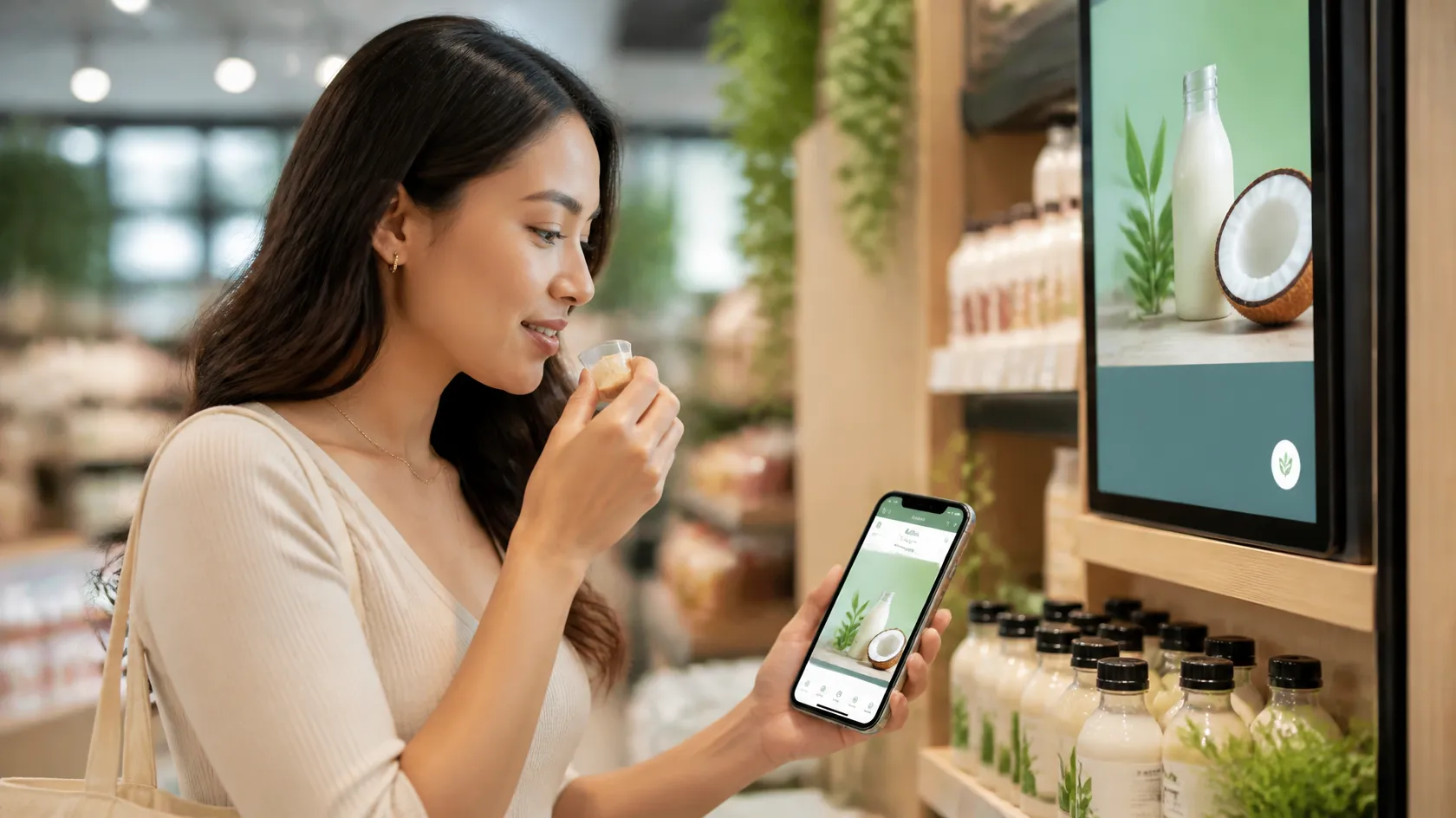
A shopper tries a new sparkling drink at a brand stand. Behind the stand, a screen is telling the brand’s story. They scan a QR code, and that screen is now theirs. They pick a flavour, see what it goes with, play a quick game, or save an offer for later.
The person behind the stand builds trust. You get the taste, the smell, the conversation. The screen adds the interaction and the personalisation. Both work together.
And the shopper controls it from their own device. Their phone today, their watch tomorrow. No app to download. No sign-up form at the counter.
Built for the kids of tomorrow
The kids at that sausage stand had nothing in their hands. The kids walking through stores today are almost never off their phones or devices.
For them, a physical experience with no digital side feels incomplete. They expect to tap, scan, share and be in control. They expect the store to respond to them.
The brands that design for them now will build the memories, and the loyalty, that last. The rest will be handing out toothpicks to people who’ve already looked back at their screens.
Memorable and measurable
The best brand experiences are the ones you still talk about years later. That’s the goal, for kids and adults alike. The difference now is that those experiences can be traced.
When the experience is connected, the brand can finally see the whole journey:
- Who engaged, and how much
- Which flavour, product or offer caught their interest
- Whether they bought, in store or online
- Whether they came back, and what brought them back
That’s the closed loop. Every in-store sale feeds back into the next experience, so it keeps getting better. A one-off moment becomes a relationship. The brand can follow up with something relevant, personalise the next visit, and learn what actually drives sales.
It changes how brands pay, too. When the loop is closed, they can pay for performance, not reach. The retailer earns more from every store visit, and the brand gets the proof it’s been asking for.
You don’t need a big network to start
Retailers don’t have to wait for a giant media network to do this. You can run experiential retail media in your own stores, on your own first-party data, inside your own cloud.
What you need is a way to join the physical and the digital. Screens that respond to the person in front of them. Experiences shoppers control from their own devices. And measurement that ties engagement back to real in-store sales.
That’s what Personalisation Hub does. It runs in your own AWS VPC, so your data stays yours, and it works with the signage you already have.
The toothpick isn’t going anywhere
Sampling has lasted because it’s human, simple and generous. Experiential retail media doesn’t replace that. It builds on it.
The free taste will still be there. The friendly face behind the stand will still be there. What changes is what happens next: an experience that responds, a memory that lasts, and a relationship that starts with one moment in the aisle.
The brands that get this right won’t just be remembered. They’ll know exactly why.
Try free on AWS Marketplace →
Or book a demo at personalisationhub.com
Read next